When I first started sourcing cable tray roll forming lines for my clients 12 years ago, I quickly learned that not all lines are created equal. I once sold a system to a electrical contractor that broke down within six months of operation—turns out the manufacturer had cut corners on material thickness and roller precision to undercut competitors on price. That mistake still haunts me, because that contractor lost three days of jobs and over $20,000 in revenue. Today, as a supplier focused on building lines that last decades, I want to pull back the curtain on the non-negotiable quality standards that separate a reliable cable tray roll forming line from one that becomes a maintenance nightmare. Cable Tray Roll Forming Line
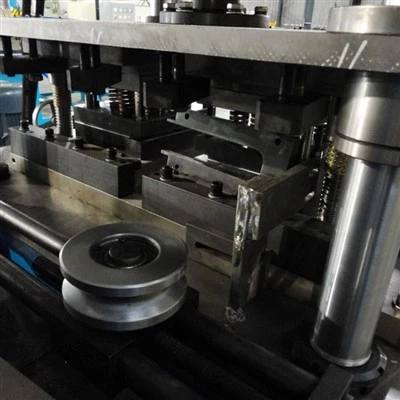
First, let’s talk about the core material that makes or breaks every part of the line: the roll tooling. Too many manufacturers use low-grade carbon steel for rollers, which wears down after just 500,000 linear feet of tray production, leading to uneven edges, dented trays, and constant line stops. The standard we enforce is premium-grade tool steel, specifically D2 or S7, heat-treated to a surface hardness of 58 to 62 HRC. That hardness isn’t just a number—our tooling lasts up to 3 million linear feet before needing regrinding, which means less downtime for our customers. We also machine our rollers on 5-axis CNC mills to a tolerance of ±0.02mm, because even a 0.1mm misalignment in roller spacing will cause the tray’s flanges to twist, making it impossible to install correctly. I’ve seen lines with 0.1mm tolerance throw out 15% of their product per run—for a 10,000-foot job, that’s 1,500 feet of scrap that could have been avoided.
Next up is the frame and main structure of the roll forming line. A lot of budget lines use thin-walled box steel welded together with low-quality electrode, which flexes under continuous operation, especially when forming thicker gauge steel. We use 20mm-thick solid steel for our main frame, stress-relieved after welding to eliminate internal tension that causes warping over time. We test our frames with a 10-ton load applied evenly across the forming area for 72 hours to ensure deflection is less than 0.5mm. Why does this matter? If the frame flexes, the roller alignment shifts every time the line runs heavy gauge material, leading to inconsistent tray dimensions. I had a customer who switched to a budget line and found their trays varied by 2mm in width—enough to require custom hangers, adding 20% to their installation cost. Our lines maintain consistent dimensions even when running 16-gauge steel all day, every day.
The power and control system is another area where cutting corners leads to big problems. Basic lines use single-speed motors and manual adjustment, which means operators have to guess the right speed for different gauges, leading to material stretching or wrinkling. We equip all our lines with variable frequency drives (VFDs) for each forming station, with digital speed control that adjusts in 0.1 RPM increments. Our control panels use Siemens PLCs with HMI touchscreens that store up to 500 different tray profiles—operators just select the part number, and the line automatically adjusts roller spacing, speed, and cut length. We also include a laser-guidance system for the cut-to-length station, which ensures end cuts are square to within ±0.1 degrees. A client in Houston told me that after switching to our line, their cut rejection rate dropped from 8% to less than 0.5%—that’s thousands of dollars saved in material every month. Don’t get me started on servo vs. pneumatic cut systems: pneumatic cuts are prone to wear and inconsistent pressure, while servo cut systems provide precise, repeatable cuts that extend tool life. We use servo-driven cut systems on all our lines, even the mid-range models, because we’ve seen too many pneumatic systems fail after just a year of heavy use.
Material handling is often overlooked, but it’s critical for both efficiency and product quality. Uncoiling is the first step in the roll forming process, and a bad uncoiler can kink or scratch the steel coil, ruining the entire run. Our uncoilers have a hydraulic decoiler with independent arm tension control, so the coil is held securely without stretching the steel. We also include a coil car to load coils safely and reduce manual handling—for customers running 60,000-pound coils, that’s not just a convenience, it’s a safety standard. The feeding section uses precision roller guides that keep the steel strip centered as it enters the first forming station, preventing side-to-side movement that causes uneven flanges. I once visited a shop where their uncoiler had no tension control, so each coil they ran had 10 feet of kinked steel that had to be scrapped before production even started. That’s 1% waste per coil that adds up fast for high-volume manufacturers.
Warranty and after-sales support are part of the quality standard too, and I’ve seen too many suppliers offer cheap lines with 90-day warranties that are impossible to enforce. We offer a 2-year full warranty on all parts and labor for our roll forming lines, plus lifetime access to technical support. We also keep a full inventory of replacement parts in our warehouse, so if a customer needs a new roller or control component, it ships within 24 hours. Last year, a customer in Canada had a roller fail on a Sunday—we shipped a replacement via overnight courier, and their line was back up by Monday morning, saving them $12,000 in lost production. Some of our competitors offer lower upfront prices, but when you factor in downtime, scrap, and maintenance costs, their lines end up costing 30% more over 5 years. We calculate the total cost of ownership with every client, and that’s where our quality standards really prove their value.
Testing and certification are non-negotiable for us. Before any line leaves our facility, we run a full 1,000-foot production test using 16-gauge galvanized steel, checking every dimension, edge quality, and cut precision. We provide a full test report with the line, so clients can see exactly how it performs before it even arrives at their plant. All our electrical components are UL-certified, and our tooling meets ISO 9001 standards. We also work with clients to customize lines for specific tray profiles—whether they’re making straight trays, bend sections, tees, or reducers, each adjustment is engineered to maintain quality. I recently worked with a client in Saudi Arabia who needed lines for trays with reinforced flanges for high-temperature industrial environments—we modified our forming stations to handle 12-gauge steel and added corrosion-resistant coating to the tooling, and the line has been running flawlessly for 18 months.
Another often-overlooked point is operator training. No matter how good the line is, it won’t perform if the operator doesn’t know how to run it properly. We provide on-site training for all our clients, covering everything from basic operation to maintenance and troubleshooting. We also offer online training modules for new operators, so they can get up to speed before the line arrives. I’ve seen lines that had all the right components fail because operators were adjusting the wrong settings, leading to unnecessary wear and tear. Our training ensures operators can get 95% efficiency within the first week of operation, instead of taking months to figure out budget lines.
At the end of the day, a cable tray roll forming line is a long-term investment. I’ve seen our lines running after 15 years, still producing consistent, high-quality trays that meet client specifications. The quality standards I’ve laid out aren’t just rules we follow—they’re lessons learned from years of mistakes and customer feedback. If you’re in the market for a new cable tray roll forming line, don’t just look at the upfront price. Ask about tooling material and hardness, frame deflection, control system precision, after-sales support, and testing protocols. Those are the factors that will determine whether your line is a revenue driver or a constant source of headaches.

If you’re ready to invest in a cable tray roll forming line that delivers consistent quality, minimal downtime, and long-term value, we’re here to help. We can walk you through our line options, customize a solution for your production needs, and provide all the support you need to get up and running smoothly. Reach out to us to start a conversation about your project and see how our quality standards can benefit your business.
Electrical Cabinet Profile Production Line References
Roll Forming Handbook, Society of Manufacturing Engineers
Cable Tray Manufacturing Standards, National Electrical Manufacturers Association (NEMA)
Tool Steel Selection Guidelines, American Iron and Steel Institute (AISI)
Weifang Yue Jun Machinery Co., Ltd.
With abundant experience, we are one of the most professional cable tray roll forming line manufacturers in China. We warmly welcome you to buy durable cable tray roll forming line made in China here from our factory. We also accept customized orders.
Address: Kuiwen District, Weifang City, Shandong Province
E-mail: adrian@yuejunmachinery.com
WebSite: https://www.yuejunmachinery.com/
